
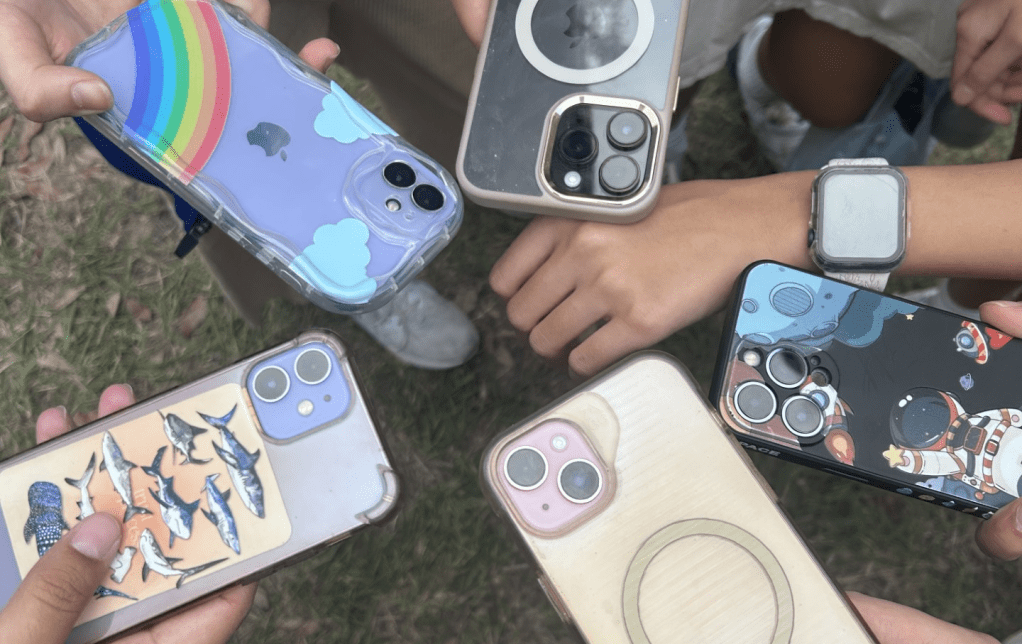
Phones are off and out of sight, as a new Texas law requires all school districts to adopt and enforce policies prohibiting the use of personal communication devices by students on school grounds during the school day.
House Bill 1841, signed into law by Gov. Greg Abbott, took effect on June 20 and was designed to cut down on distractions.
“Educators and researchers have raised concerns about the impact that smartphones have on student learning and student engagement,” Governor Abbott said.
Students across Texas have protested this law since it took effect. At James Madison High School, a public school in Houston, about two dozen students walked out in protest after the school put in stricter phone ban rules. A junior in Mansfield ISD even gathered 135,000 signatures to launch an objection against the ban.
Although there have not been any protests at Pin Oak, perspectives among the students and staff are clearly divided. 8A English teacher, Sabrina Woodard, saw the phone ban as overdue.
“I have been waiting for 23 years for a policy on the phone,” Woodard said. “I love the new phone policy because I am a stickler about not having a phone and it’s a total disruption to class. The minute it starts buzzing in your pocket, it’s like you guys have a little itch.”
For seventh grader Jonathan Bourret, the concern isn’t distraction, it’s safety.
“I don’t like the phone policy because in an emergency, like a school shooting or a fire, you might need to text your parents,” Bourret said.
School shootings and gun violence have been a major concern for students like Bourret. According to the CNN article “School Shootings in the US: Fast Facts,” there were 366 school shooting incidents nationwide from 2020 to 2025. In just the first two months of the 2025-26 school year, 47 shootings already caused injuries and deaths.
While students like Bourret fear the policy could put them at risk in an emergency, A House administrator Jeremy Gates said that staff have established necessary emergency procedures.
“We have a phone in every single classroom,” Gates said. “If there is an emergency situation, students should ask for permission to use the classroom phone or to the house or front office.”
In a Team Time survey across three grade levels with nearly 300 students, 80% said the policy makes them feel less safe, pointing to the fact that one classroom phone isn’t enough in an emergency. Meanwhile, 20% said the policy makes them feel neither more nor less safe.
Although students like Bourret remain worried about the policy, not everyone shares his anxiety. 8C student Santiago Camacho sees the rule differently.
“I think the phone policy is good because students can lock in with their assignments, and they won’t have to be cheating with their phones during school so they can get smarter,” Camacho said.
Camacho’s support shows that some students see the phone ban as a chance to refocus, and he is not alone. In the same survey, 25% admitted that having phones nearby makes them want to use them instead of concentrating. Seventy-five percent of students think that the policy is minimizing distractions and helping them focus more in class.
In the classroom, 8C science teacher Presley Girard watched the new rule quietly change how students behaved and worked.
“Overall the policy is definitely minimizing distractions,” Girard said. “Keep your phones in your bag Chargers!”

