
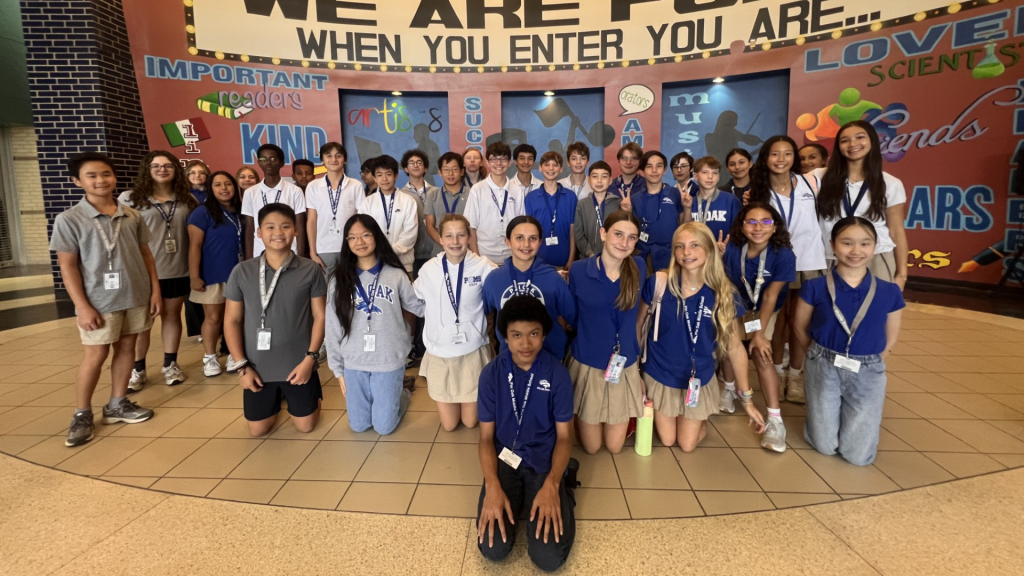
Blazers pressed, portfolios stacked neatly in hand, and prototypes carefully wrapped for transport, Technology Student Association members arrived at their regional competition on Feb. 13-14 at Clear Springs High School ready to compete.
TSA is a nationwide student organization for middle and high school students who are interested in careers and hands-on learning through Career and Technical Education. It consists of on-site events, which are completed at the competition, and non-site events, which are completed before the competition. Pin Oak’s chapter, which is led by CTE teacher Brandi Martinez, is not limited to computers or coding and extends far beyond a single career pathway.
“It does not stop at technology,” Martinez said. “So when we look at TSA, the purpose of it is really to make sure that everyone has a chance to not only pick something that they enjoy creating, but also something that would reference their future career, be it technology related or medical field.”
Preparation for the regional competition required coordination, practice, and an additional two to three hours of work outside the normal school day during the two weeks leading up to the event.
“They came in after school and before school almost every single day, staying late, taking projects home, working with groups, just grouping together very well to make sure that they were able to get their projects done,” Martinez said.
Student leadership played a key role in how smoothly this year’s regional competition ran. As TSA president, Zed Ibeawuchi helped prepare students and organize events leading up to the competition.
“I have to make sure that all of the members are organized and aren’t confused on what events they’re doing and how to actually complete them,” Ibeawuchi said. “So a big part of my responsibility is trying to assist them in understanding their projects.”
The path to the regional competition had setbacks. Material delays and time constraints created pressure as the competition approached.
“There were some district funding issues where our materials were not getting approved on time, we kept getting a lot of material requests rejected,” Martinez said. “Some of them took over two months to get here, but kids stepped up and a lot of people ended up getting their own materials.”
For TSA member Gavin Cedars, challenges of getting his group’s materials showed the importance of teamwork in completing his projects.
“You have to know when to coordinate with your teammates, or you’re not going to finish in time,” Cedars said.
Beyond the placements themselves, Martinez reflected on how students represented their school during presentations and testing.
“Looking at how our kids looked versus other kids who were there, even high schoolers, everybody came in looking professional,” Martinez said. “They presented themselves well, speaking wise, which really spoke highly of our school and made me happy as an advisor.”
Martinez knew that the team would win events at the competition after seeing how well students were meeting their deadlines for their projects.
“I automatically came into this with the expectation that we were going to win first place in almost everything,” Martinez said. “Not necessarily surprised, but impressed that [TSA students] were able to pull off the vision that I had of so many first place wins.”
Regionals served as preparation for future state and national competitions, giving members the chance to observe how competitions operate and review judges’ feedback so they can refine projects, and avoid breaking specific rules before advancing to the TSA state competition.
“One important part of regionals is the judging feedback and actually seeing how the competitions play out,” Ibeawuchi said. “I think personally that actually seeing how the competitions go is a lot more important than the feedback, but the feedback is definitely important as well.”
By the end of the competition, the team had earned 64 first-place finishes, 18 second-place finishes, and five third-place finishes across a range of on-site and non-site events, with 41 students qualifying for the TSA State competition.
“Everybody who placed first, second or third automatically is going to rotate into our state championship, which is going to be held in Dallas, at the beginning of April,” Martinez said.
Ibeawuchi is already setting higher expectations for himself as he prepares for the state and national competitions. He hopes to improve on last year’s results and show how much he has improved.
“For state my goal is to place first because last year I placed second in coding and I want to place first now, because I know a lot more coding than I did last year,” Ibeawuchi said. “For nationals, my goal is for all of my events to get top five, and hopefully I’ll do even better to show how much that I’ve grown from last year.”
One of the most difficult aspects of advising TSA is maintaining the balance between mentorship and independence, as a student’s project will be disqualified if an advisor helps them complete it.
“It’s a really difficult job to juggle between the two because as the advisor slash teacher, if you see a kid struggling with something, you automatically want to take the reins and just show them how to do it, but that’s not really what happens with TSA,” Martinez said. “I can’t physically do that for you as a TSA student, so it’s really hard to step back and watch people fail or struggle because I have to submit what’s given to me. “
TSA expanded from 31 members last year to 52 this year. As it has grown, outside organizations have increased interest in connecting with its members.
“I’m constantly getting invitations for competitions and outside field trips,” Martinez said. “Exxon and Chevron and all these companies are asking me to pull kids now to do engineering workshops and things like that.”
As students look ahead to future competitions, Martinez hopes they remember that TSA is ultimately about helping students discover new opportunities.
“TSA and other organizations that are put together are here in place to help you guys get exposure to other realms that school does not give you,” Martinez said. “We’re here to help you grow, to help you find new passions, to give you inspiration for your future.”
 Pin Oak Press