
Sixth grader Eddie Li leans over his Chromebook, testing the futuristic AI controlled power grid app he’s building for Charger Fest. Across the table, seventh grader Nathan Lustgarten scrolls through a set of photos he uploaded into an image recognition model, checking whether it correctly sets each picture with the colors and words he assigned. Nathan groans when Replit, a browser‑based coding platform with built in AI tools, flashes its “three prompts left today” warning, the free version limits how much they can test before the system locks them out.
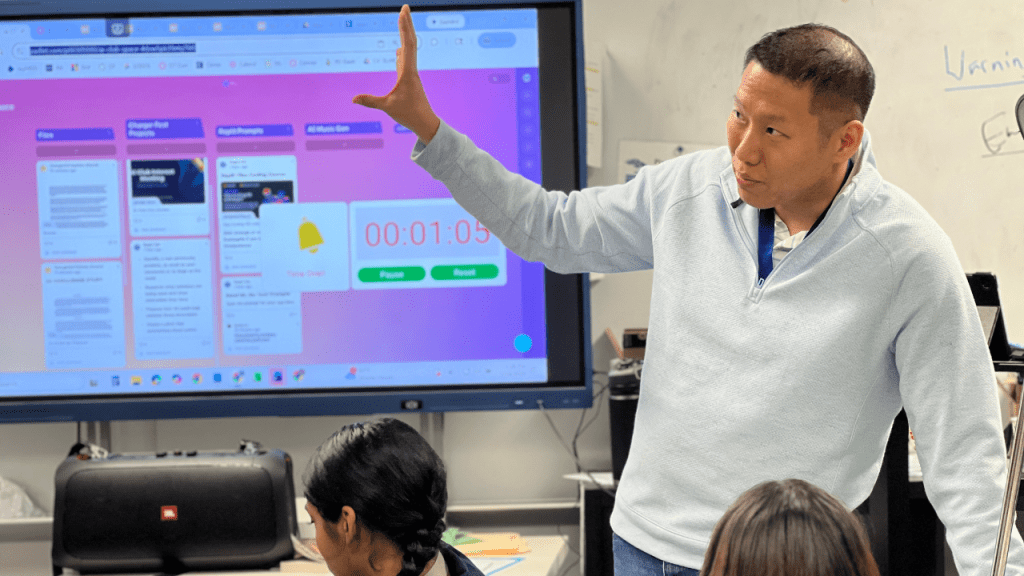
The AI club, sponsored by seventh grade English teacher Roger Mu, teaches students how artificial intelligence works by letting them experiment with projects and challenges. In one meeting, members raced to create an AI‑generated poem with rules using only three prompts and a two‑minute time limit, making them think carefully about how they worked the model.
“I was inspired to start the AI Club because I heard about the AI Presidential Challenge, which was a contest where the federal government was offering a prize to develop AI solutions,” Mu said.
When Mu proposed the club to school administrator Sarah Hall, he explained that he wanted students to use AI to solve real problems around them. Lustgarten suggested designing a better water‑fountain system after noticing how often the ones at school break or stop working.
“The main goal of the club this year is to get a project ready to show at Charger Fest and to build an AI solution that can help the community or their own personal lives,” Mu said.
One of the tools Lustgarten explored was Google’s Teachable Machine, an image recognition platform that lets users upload photos and train a model to sort them into categories. He experimented with it by giving the system sets of images and teaching it how to tell the difference between them, and after a few rounds of training, the model was able to correctly identify most of the new photos he tested.
“It can remember what a picture looks like and associate it with colors, numbers, words, whatever features you want,” Lustgarten said.
Before joining the club, Lustgarten only had a basic idea of what AI could do.
“I knew AI is like the future of, you know, everything,” Lustgarten said. “I wanted to be able to learn about this technology right now so it can help me when I learn about it more later in life.”
Li joined the AI Club because he was curious about how artificial intelligence could be applied in situations where accuracy and safety matter far more than they do in everyday schoolwork.
“So for some things, like maybe surgery or medical stuff, AI can help us to do the surgeries more efficiently and it can result in less catastrophes,” Li said.
In addition to learning about AI’s impact on different industries, members spend much of their time building simple tools like games, calculators, or early versions of the apps they hope to develop later in the year. Replit is the main platform they use for that work.
“It’s not like ChatGPT for basically everything,” Li said. “It’s more programming and designing, and Mr. Mu wants us to create an app, and it works really well for that.”
As he kept working on the project, Li realized the process was more frustrating than he expected. He would type out a prompt, wait for the screen to fill with code, and then watch AI produce something completely different from what he expected. Sometimes the program froze or showed error messages he didn’t recognize, and he found himself deleting chunks of text, rewriting instructions, and trying again.
“The hard part was making it specific enough that the AI knows what to do, but not so specific that it confuses even myself when I’m reading,” Li said.
Lustgarten explains that the club has pushed him to think about how AI could improve systems that depend on efficiency and resource use, especially in agriculture.
“I got to partake in the AI Presidential Challenge, where we had to use AI to be able to create something that can be used to benefit or help the U.S. My project design was making farming drones,which are able to also use a native speaking, which means that they can understand some slang words.” Lustgarten said. “It’s able to analyze the needs of the crops and apply specific nutrients needed for the plant to grow instead of wasting extra on it so it can cut back resource use and save the economy a lot of money.”
The AI Club brings together students from different grades, each working on projects like chatbots, image recognition models, or simple games. Mu has more information for anyone curious about joining or seeing what the club is creating next.
 Pin Oak Press