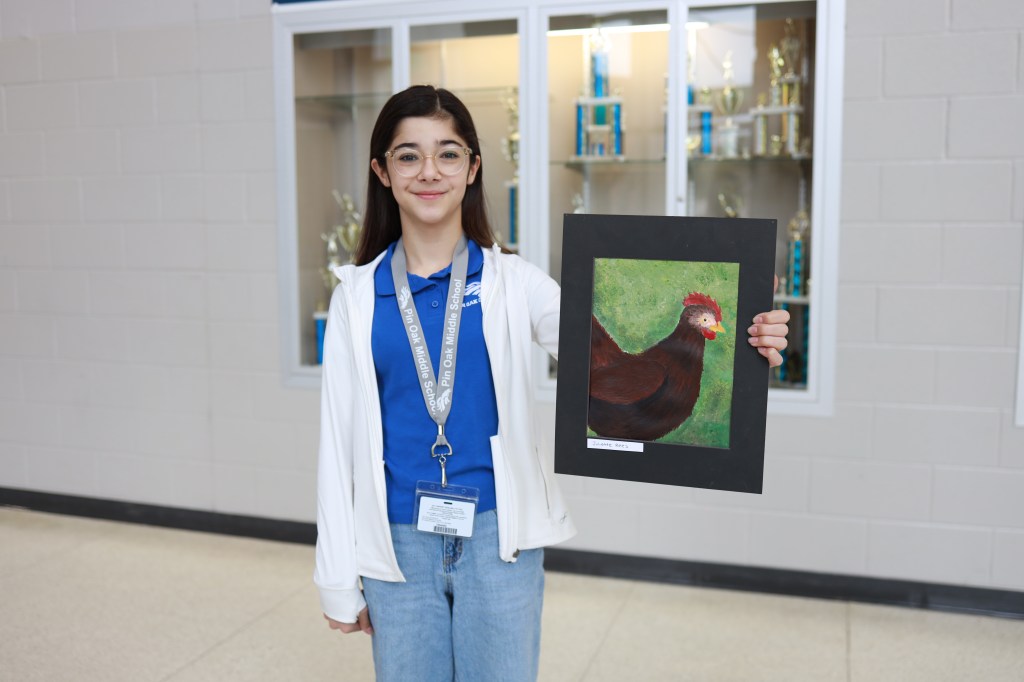
Juliette Rees has hatched something special—a detailed painting of a chicken currently displayed outside the art room as part of a selective showcase recognizing outstanding student artwork. Chosen for her strong technique and creativity, Rees’s piece was handpicked by the art teacher, who rotates displays but ensures only the most well-executed and unique pieces earn a spot.
For as far back as Rees can remember, she’s had a passion for art. As a young child, from crayons to cardboard cutouts, she would find ways to use and express her creativity. Rees’s parents supported her passion by providing supplies once they saw her love for art.
As Rees got older and her love for art deepened, she faced more challenges, particularly struggling with having the courage to pick up a pencil and draw. For a while, her perfectionism took over, making it hard for her to enjoy making art.
Despite these challenges, she eventually found her passion to make art the way she had before.
“Confidence is key when painting, sketching, or using any type of multimedia to achieve your vision,” Rees said. “With that, sometimes I still struggle to find enough confidence to show my artwork, however, it rarely happens anymore.”
Rees takes pride in how much she has grown, continuously improving her art throughout the years. For Rees, looking back on her art from years ago makes her proud.
“I think my artwork reflects how far I’ve come since my original sketches as a child,” Rees said. “I went from drawing stick figures watching fireworks to creating realistic eyes, faces, animals and more.”
Rees’ growing love for art made her even more excited about the rodeo-themed project. Her dedication and new skills helped her create a chicken painting, which is now proudly on display.
With the rodeo approaching March 14-29, her project was to paint a rodeo-related animal without exactly replicating the reference image. Rees chose a chicken, her favorite rodeo animal, and got to work on her project. She started with a sketch, and once she finished that, she started to bring the sketch to life with paint.
She was proud of her work, knowing that just a year ago, she wouldn’t have had the courage or the amount of experience she has now to create this painting.
“This project took a very long time to finish, but the result was very worth the time and effort I put into it,” Rees said.
Although Rees was delighted with her work for the looks, what really made her happy was the personal growth her painting represented.
“I think that is an achievement that I will have in the back of my mind whenever I doubt myself while doing art,” Rees said.
For Rees, this project showed her that she could create art better than she expected. More importantly, it gave her the confidence to share her work with others.
Rees’s art was hand-picked to be showcased by Naomi Castillo, an art teacher at Pin Oak Middle School who appreciates the techniques used in her artwork.
“What I liked about it is the color that she chose for it and the way that she applied it,” Castillo said. “It shows a good technique and skill level for applying color evenly. And the values were well done.”
Castillo’s appreciation for Rees’s use of color and technique highlights the high standards she upholds when selecting student artwork for display. She carefully evaluates each piece based on innovation, implementation, and how well it meets the objective.
“I choose the artwork based upon who executed the objective thoroughly and most creatively and then I try to give everybody an opportunity,” Castillo said. “So if they’ve already been displayed, then I’ll find someone else who met the objective and display theirs, and then I change them out based upon whatever we’re working on.”
Castillo emphasizes that artistic success isn’t about perfection from the start. She believes that growth comes from failure and error, encouraging students to embrace mistakes as part of the creative process.
“First, let me say that I’m a firm believer in making bad art,” Castillo said. “You have to make a lot of bad art in order to be able to make good art. Perseverance and a willingness to take risks is what makes an artist ‘good.’”
Castillo encourages her students to take risks and not shy away from making mistakes. She reminds them that even the most famous artists, including art teachers and masters, have all struggled on their path to greatness.
 Pin Oak Press