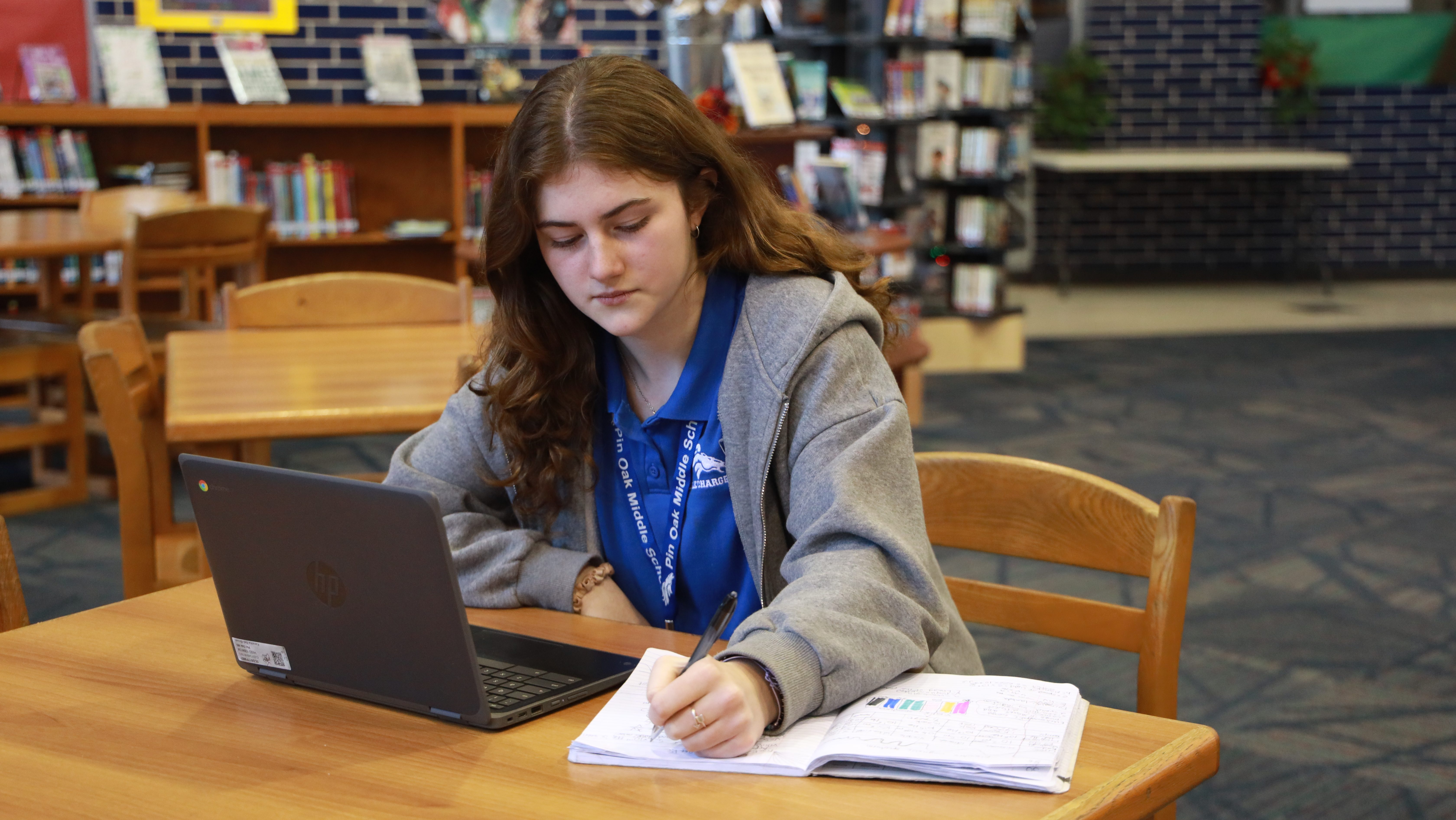
Every day, eighth-grader Ava Worley stresses about her next big step: high school. While Ava plans to leave public school behind and make the switch to private, many of her classmates and their families are wondering whether it’s worth the cost. As high school tours began Sept. 3 and applications open Dec. 10, Pin Oak’s eighth-graders are weighing their options—and their futures.
High school is a crucial time for students to start to figure out what they want to do with their future, which often begins with important decisions about where to attend school.
An article by Richard Murnane of Education Next titled “Who Goes to Private School” states that,“the reasons behind these decisions are as individual as families themselves: some may perceive the quality of education to be better at a private school than their neighborhood school.”
The reason for this belief is that smaller class sizes give students more one-on-one time with teachers and allow them to receive more personalized help and assistance. Also, a smaller teacher-to-student ratio provides students with more immediate feedback and extra support on a challenging topic.
Worley believes these qualities set private schools apart. “I think that private schools are a lot more prestigious, and they have higher expectations for their students. I think it’s always good to push yourself for higher expectations.”
For people who might be at a financial disadvantage, the thousands of dollars for private education is just too much and they do not have the means to go. But it’s important to keep in mind that there are many different personal opinions and factors that will affect people’s decision-making. Here’s a look at the factors influencing families’ decisions and the benefits of both private and public schooling.
Despite the high cost, private schools offer significant benefits. For students who need smaller learning environments, private is a great choice as there is a smaller number of students in each class which maximizes the attention and focus given to each student. According to ThoughtCo.’s 2019 article “5 Major Differences Between Public and Private Schools,” private high schools will typically have around 10-15 students per class.
Another benefit is that private schools aren’t part of a district, so they can make their own rules about dress codes, AI use, and other policies.
Many are aware of the changes being made in HISD, like fewer elective options and more standardized tests as a result of the HISD district takeover. In contrast, private school principals have greater autonomy over policy decisions, allowing them to consider student input and adapt to their schools’ specific needs.
However, for many families, public school is the most efficient due to location, transportation, largely automatic admission, and affordability. According to the U.S. News and World Report, public schools still attract far more students than private schools, with over 50.8 million students attending public school as of 2019 and only 4.7 million students opting for private. This is because of the extremely high cost of private education.
“I would most likely pick public schools because…we don’t have to pay money, and I know that for private schools you have to pay a lot of money,” Saanvi Nigam, an eighth-grader in C House, said.
For some students, class size is a defining factor in their decision. While smaller private school classes may offer more individual attention, Nigam believes larger public school classes provide a better social environment.
“I feel like if I was in a smaller class, I wouldn’t be able to socialize as much, but being in a bigger class means that I would be able to be in a friendlier environment with lots of people,” Nigam said. “I would also get much more of a high school experience if I went to a public school.’”
Many families prefer to send their students to neighborhood schools that are free. This trend is highlighted in a Pew Research Center article titled “U.S. Public, Private and Charter Schools in 5 Charts,” which states that private school enrollment made up just 10% of all U.S. school enrollment in 2022.
Another reason families choose public schools is the desire for their students to gain experiences that prepare them for college, careers, and life beyond high school.
For some students, familiarity and comfort play a major role in their decision. A House eighth-grader Lila Elliot doesn’t see the need to make the switch.
“I’ve been going to public school for my whole life, and I just feel more comfortable there,” Elliot said.
According to the National Center for Education Statistics, “Of the 49.6 million students enrolled in public elementary and secondary schools in fall 2022, 22.1 million were White; 14.4 million were Hispanic; 7.4 million were Black; 2.7 million were Asian; and 3.1 million made up other racial groups.”
However, “among the 4.7 million who were enrolled in private schools in fall 2021, 65 percent were White; 12 percent were Hispanic; 9 percent were Black; and 7 percent were Asian or made up other groups.” This data highlights that public schools are more diverse than private schools, largely because they are more affordable.
Like Ava, Pin Oak students must decide where to take their next big leap as they look ahead to high school and beyond. The HISD 2024-2025 School Choice application is now open. To see the timeline and important dates, visit blogs.houstonisd.org.
 Pin Oak Press